
Diesel: South Africa’s last line of defence for Energy Security — now at risk


Diesel: South Africa’s last line of defence for Energy Security — now at risk
– By Dominic Goncalves, Advisory Partner for Energy Strategy at Cresco Project Finance, Founder & Director of Naviara Energy
South Africa faces two main energy security risks: electricity reliability and diesel dependency. The Strait of Hormuz crisis has informed us that Diesel is no longer a guaranteed “last line of defence”.
Had an external shock like the Strait of Hormuz closure occurred during a time of load-shedding, there would be serious pressure on diesel availability to power on-site generators for critical loads such as hospitals and data centres, not to mention various industrial, commercial, agricultural and residential consumers to provide back-up power during load-shedding events.
Diesel has always been the last line of defence for power systems globally and in South Africa – the reliability and availability of diesel means that, despite it being expensive, it has always been relied upon – its availability has hardly been questioned – until the Strait of Hormuz crisis has exposed an energy security risk at the fuel level and at the on-site, back-up level for critical loads.
South Africa has now experienced three severe load-shedding crises (2008-2009, 2014-2015, 2022-2023) and is in the midst of a global fuel supply crisis as of February-April 2026. What would happen if these were to happen together, and what could occur to revert Eskom to a load-shedding situation while the Hormuz closure, affecting diesel supply, rages on?
Firstly it is important to note that while Eskom’s reserve margin is currently stable, in the next 3-4 years South Africa is forecast to return to load-shedding if Eskom’s decommissioning schedule is followed – which would remove almost half of Eskom’s aging coal fleet, without adequately replacing these assets with sufficient load-following technologies such as LNG, Coal, Nuclear, BESS or grid forming inverters.
Cresco’s National Energy Balance model predicts a widening system imbalance where there will be deficits in the early morning and evening hours, which will require increased diesel usage by Eskom to follow the load of the renewables fleet, which are currently being installed without enough batteries or grid-forming inverters to provide dispatchability – meaning that the grid will have an excess of renewables at certain times of the day, but a shortage during other times of the day, as well as during periods of cloud cover and low wind,, for example during winter months.
During the load-shedding period of the financial year 2024 Eskom’s diesel bill was R26.6 billion, fuelling the OCGT peaker plants to generate 3,634GWh of electricity from diesel to avoid load-shedding as much as possible.
Since then, Eskom’s diesel consumption has dropped 68%, moving from emergency usage to intermittent peaking and balancing support functions.
As of March 2026, only 2 of 5 local diesel refineries in South Africa are operational, and around 57% of SA’s total refined diesel supply is shipped via the Strait of Hormuz.
Since 2022, South Africa’s domestic diesel refining capacity has halved – the shutdowns of SAPREF and ENREF have turned South Africa from a relatively self-sufficient refiner of diesel products to a structurally import-dependent country (70-75%), exposed to global diesel markets and highly sensitive to shocks like the Hormuz disruption.
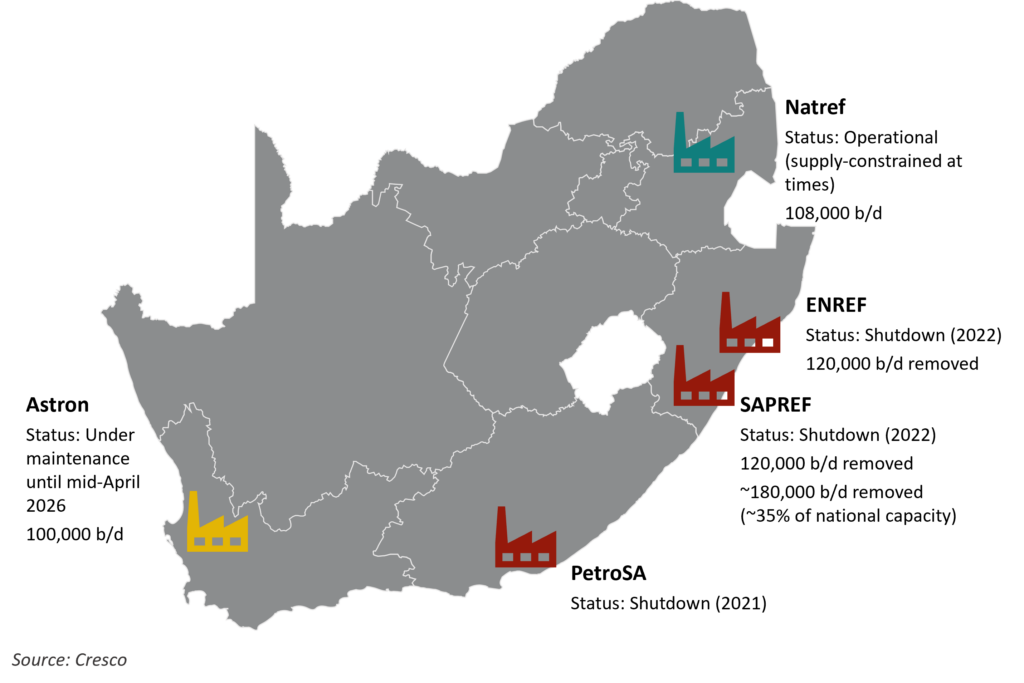
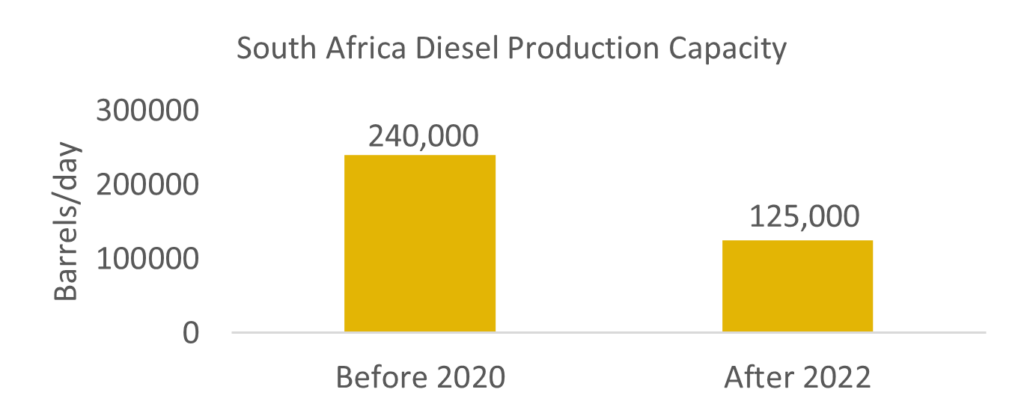
Between 2022 and 2026, South Africa’s local diesel refining capacity stabilized at ~50% of previous capacity (pre-2020). During the last six years, South Africa lost its production role, resulting in higher price and availability risks and has lower resilience in the face of energy security shocks, both locally and globally.
More than half of South Africa’s diesel is currently imported from Gulf suppliers directly exposed to Hormuz disruption such as Oman (34%), UAE (12%), and Bahrain (11%), or indirectly exposed to Hormuz disruption via supply chains such as India (20%).
Currently, as the Strait of Hormuz disruption reaches its 6th week, SA is having to compete for non-Gulf barrels against stronger buyers such as Asia and Europe. India is acting as a swing supplier, reallocating barrels to the highest-paying market (Asia).
While South Africa has not declared a national diesel shortage but is currently experiencing pricing shocks, logistics disruption and localized shortages – a key outlier variable is what would happen in the face of an internal shock (Eskom return to load-shedding) in addition to the external shock currently faced (Hormuz closure)?
Firstly, it’s important to understand the consumer split of Diesel consumption in South Africa.

During stable periods, Eskom uses only 3-10% of the country’s diesel supply, for load-following and system balancing functions for the country’s 4 OCGT peaker plants.
During load-shedding periods however, this percentage ramps up to 20-30%. This highly volatile swing demand has a larger impact: during times of load-shedding and load curtailment, private consumers – whether industrial, commercial, agricultural or residential – also increase diesel demand to power on-site diesel gensets.
This means that any deterioration in Eskom’s fleet performance over the coming weeks could result in a spike of the national diesel demand more than 20-30%, on an already strained import situation.
Eskom’s current system status
Eskom is currently doing a remarkable job ensuring a stable grid with a troublesome and aging fleet of assets. 17.7GW of Eskom’s coal assets are scheduled to be decommissioned by 2035 – about 40% of South Africa’s grid – with insufficient replacement generation planned.
- Currently, all main metrics used to determine the health and stability of South Africa’s power system (EAF, PCLF, UCLF) are stable.
- EAF has tracked consistently above 60% over the last 8 months, while UCLF has tracked around 20%.
- UCLF refers to the unplanned capacity loss factor, or amount of generation capacity that is offline due to unplanned outages at a given time.
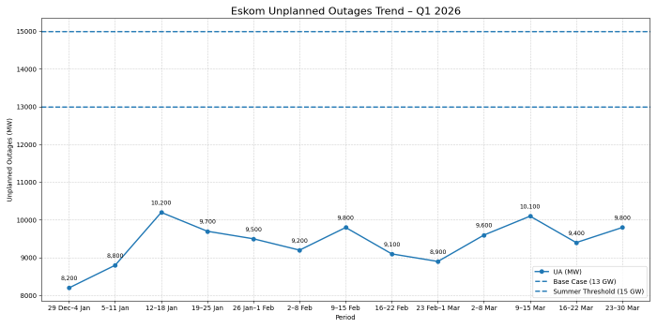
- In Q1 2026, Eskom had 8.2-10.2GW of capacity offline.
- Load-shedding risk is usually triggered once around 15GW of capacity is offline under the current system operator conditions. This means that currently Eskom has at least 4.8GW of ‘headroom’ prior to even reaching what could be considered a low level of load-shedding risk.
Risk Level | UA Range (MW) | System Status | System Operations | Load-shedding and Curtailment Risk |
🟢 No Risk | 8,000-13,000 | High reserve margin, standard operations | Standard dispatch + minimal Diesel OCGT peaking for system balancing | No load-shedding |
🟡 Low Risk | 13,000-15,000 | Tight reserve margin | Increased pumped storage hydro + Diesel OCGT usage | Very low risk, only during peak periods |
🟠 High Risk | 15,000-17,000 | Insufficient reserves | Extended peaking and demand response to avoid load-shedding (increased Diesel OCGT usage) | Potential for short-term load-shedding events during peak periods |
🔴 Severe Risk | 17,000+ | Demand exceeds available supply including emergency reserves | Emergency reserves depleted | Sustained load-shedding |
Source: Cresco, Eskom, NTCSA
What would it take to burn through this 4.8GW of headroom – causing low load-shedding risk – and what would it take overall to re-enter load-shedding?
Cresco evaluated two Stressed Test scenarios at concept level:
- Multiple Coal Unit Trips + Delayed Recovery
- Minor Coal Unit Trips + Diesel / OCGT Constraint
Background to the Stressed Test Scenarios
- Multiple unit trips at Eskom’s aging fleet of coal plants are not uncommon.
- On 22 February 2025, five units at Majuba tripped (more than 3GW) when a transformer was overloaded.
- The ‘frequency event’ caused by the Majuba trip caused a trip at Medupi of another 800MW.
- The 3,800MW unplanned loss of power triggered Stage 3 load-shedding.
- At this point, an unconnected incident at Camden caused four units to be lost due to failure on a hydraulic valve that hit the station’s cooling water pumps.
- Ten units were therefore offline due to unplanned events.
- Load-shedding was then escalated to Stage 6 for February 22-26.
- During these 4 days of Stage 6, grid unavailability was 24 hours in total or 6 hours a day for 4 days for some affected consumers.
- On-site diesel ride-through capability would need to cover such a potential repeat scenario in 2026, albeit with different dynamics – increased diesel supply risks and increased pricing caused by the Hormuz global supply shock.
- Any shortage of diesel caused by the Hormuz crisis during such a frequency event could result in inability for commercial, industrial, agricultural and residential consumers to fuel on-site diesel generators during load-shedding.
Scenario 1 – Multiple Coal Unit Trips + Delayed Recovery
What would it take to revert to load-shedding from Eskom’s currently healthy system status?
Cresco analysed a scenario where several aging coal units trip within 1–3 days at multiple stations, plus one large 800 MW unit derates or trips, and the situation is exacerbated by boiler tube leaks, conveyor, coal quality, or balance-of-plant constraints at 2–3 additional units, which prolong the recovery time of replenishing the system.
An example build up of this could be:
- 4–5 older 600 MW coal units trip or partially fail across weak assets e.g. Tutuka, Kriel, Matla, Duvha, Lethabo, or Kendal (2.4 – 3GW)
- 1 x large newer unit (800MW) at Kusile or Medupi has a full outage
- Boiler tube leaks / conveyor / coal quality / balance-of-plant constraints at 2–3 additional units (1.5 – 2.5GW)
The result: multiple trips plus poor recovery erodes Eskom’s current healthy reserve margin, resulting in unplanned outages of 4.5 – 6.5GW over several days. As the coal units trip and repair times are extended due to boiler leaks and other issues, available capacity remains suppressed across multiple consecutive peaks. Over consecutive evening peaks, pumped storage hydro depletes and Diesel OCGT usage ramps up. If the system cannot recover between the evening peaks, after 4 days Eskom will likely implement Stage 1-2 load-shedding.
Scenario 2 – Minor Coal Unit Trips + Diesel / OCGT Constraint
Cresco analysed a second scenario, where only moderate coal unit trips are combined with Diesel OCGT constraints. In this scenario, OCGT dispatch is constrained by a diesel supply shortage or constraints due to price shock; pumped storage is heavily cycled; coal unplanned availability rises only moderately.
For example:
- 3-4 older 600 MW coal units trip or partially fail across weak assets e.g. Tutuka, Kriel, Matla, Duvha, Lethabo, or Kendal
- Eskom cannot sustain Ankerlig / Gourikwa / IPP OCGT output due to diesel unavailability or price shocks
- Pumped storage hydro depletion + several days of weak RE penetration (PV/Wind) reduce evening peak margin
The result: several unit trips coupled with reduced flexible reserves (diesel, hydro) result in return to load-shedding. Under this scenario, all fast-response reserves are exhausted simultaneously. The system is unable to provide multi-day peak support due to energy constraints. Load shedding is therefore triggered by energy depletion – leading to Stage 1-2 load-shedding.
Conclusions and Key Takeaways
In the near term, load-shedding is unlikely although possible. In the long term there is a higher probability that load-shedding will return for periods from 2029 onward. What the Strait of Hormuz crisis has taught us is that we can no longer rely 100% on diesel for the future. Any major geopolitical risk or war could fracture supply chains and turn the ‘option of last resort’ into a difficult-to-obtain fuel source.
Perhaps surprisingly, renewable energy and batteries – particularly high renewable penetration microgrids – are the best long-term structural resilience against fuel shocks. Microgrids – typically coupling solar and batteries – are usually deployed on-site, and minimize diesel consumption for critical loads.
By oversizing solar and batteries, microgrids can reduce reliance on diesel by more than 90%. New technologies such as grid-forming inverters enable microgrids to provide blackstart and islanding capability, meaning a seamless transition to the solar and grid powered batteries during grid outages. And a significantly reduced need to run diesel generators as back-up.
Such microgrids therefore enable critical load customers a much larger resilience buffer in the face of emergencies – being less reliant on diesel means smaller required on-site storage facilities, reduced fuel logistics, and reduced susceptibility to diesel’s volatile price swings as can be seen in times of crisis.
Renewable energy microgrids therefore are a hedge against fuel costs, fuel shocks and geopolitical events, providing on-site energy security during crisis events. Being less reliant on imported fuels enables users to reduce costs and minimize risks.
At a national level, South Africa needs to deploy BESS at scale, reducing fuel needs and diesel reliance during peaking hours. The rapid deployment of renewable energy is not being backed by enough batteries and grid-forming technologies to avoid supply-demand imbalances on the grid in the future.
At a commercial, industrial and agricultural level, South African businesses that are regarded as ‘critical loads’ should explore on-site microgrids – an investment that will likely pay off during the 20 years of investment ahead – a period that at least in South Africa, will have some periods of load-shedding, and the international impacts of future wars or conflicts to stifle diesel imports are not known.